
It was so wonderful to see so many at the 2026 Peasmarsh Chamber Music Festival!
A huge thank you to all those that came to join us (well done for managing in the heat!), and to the artists who – despite very warm conditions indeed for the duration of their rehearsals and performances – played wonderfully. I think we are all a little bit in awe of how they managed it. For those of you that weren’t able to make it to Sussex, many thanks to Alexander Stiller who has written a piece (below) about the festival – with thanks to photographers Walter van Dyck and Ina Wieczorek for capturing the Festival so beautifully.
Thank you so much for your continued support, and we hope to see you all again in Peasmarsh next year – please save the dates (24-27 June 2027).
***
Whoever suggested that the 2026 Festival should open with Haydn’s late, great ‘Sunrise’ quartet gave the most appropriate solar start to possibly the best, certainly the hottest, Festival of them all.
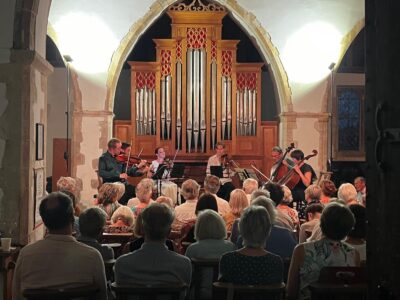 With a plentiful supply of chilled water to ensure that musicians, support teams and audience could manage the heat, four of the superlative group of 2026 guest artists, Oliver Heath and Maja Horvat (violins), Edgar Francis (viola) and Kate Gould (cello) began proceedings on the Thursday with the magical Haydn. Co-director cellist Richard Lester then joined another guest, pianist Marianna Shirinyan in a lively performance of Britten’s Opus 65 Cello Sonata, written for Rostropovich and ‘brilliant, quirky and original’ or ‘not really music’, as I overheard it described during the interval; take sides on this as you like.
Post-interval, violinist/co director Anthony Marwood led four of the aforementioned string players together with violist Jennifer Stumm, in a deeply felt and powerful performance of Brahms’s second string sextet; the first concert of 2026 had already shown that 2026 would be a most singular occasion.
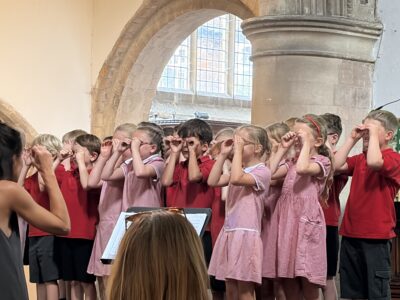 As has become customary, St Mary’s Church in Rye was the venue, just after midday on the Friday, for Sam Glazer and Tara Franks, after touring our local primary schools, to present the children’s brilliant efforts at composing; remember, this involves choosing a theme and then writing music, words and a presentation scenario, all in one day, for public performance.
As we have come to expect, the school groups excelled themselves with Sam and Tara’s guidance and all was superbly supported by more outstanding special guests: the Astatine Piano Trio. This educational outreach work is regarded as one of the Festival’s most important activities beyond the concerts themselves and is supported generously by the Rudi Martinus van Dijk Foundation and many local benefactors.
Friday evening in St Mary’s brought us still more brilliant visitors in the shape of the Britten Sinfonia, directed by Marcus Barcham Stevens; it was a real pleasure to see and hear Richard Lester and Kate Gould together, playing Vivaldi’s concerto for two cellos, wonderfully accompanied by the Sinfonia who then gave us a steely and vivid interpretation of Schubert’s ever-popular fifth symphony. Anthony Marwood recorded Peteris Vasks violin concerto ‘Distant Light’ in 2004, a year later than my first Festival visit and some years ago, Anthony gave us a very special account of it in St Mary’s. His immensely dramatic and expressive performance of the same work to end this Friday evening was even more memorable.
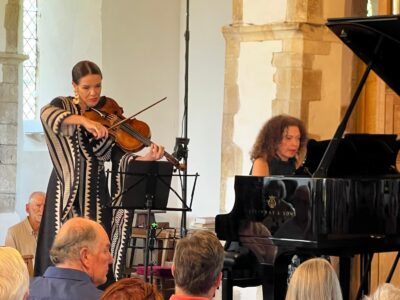 So we were on to the weekend when, with three concerts each day, the momentum really ‘hotted up’, the weather keeping pace. The Saturday morning brought more Haydn (the opposite of hardship) with the Astatine Piano Trio, Maja Horvat (violin), Riya Hamie (cello) and Berniya Hamie (piano), playing, beautifully, one of his piano trios, another form the great man virtually invented as it is understood today.
Schumann followed with Jennifer Stumm and Marianna Shirinyan making the Marchenbilder (Fairy-tale Pictures) Opus 113 an expression of the composer’s melancholy dreamer side, Eusebius, and his contrasting lively, impetuous Florestan side.
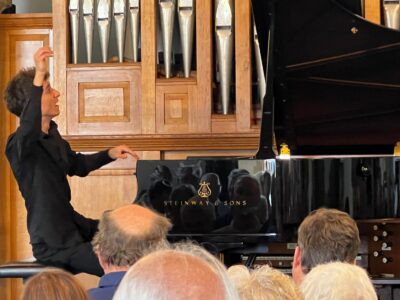 Post-interval the last of the guest artists joined us, the young Hungarian pianist Valentin Magyar. It is hard to believe that any pianist approaches the Liszt sonata in B minor without some trepidation but Magyar is clearly a special player and as well as mastering completely the technical demands of this great work, he also gave us one of the most convincing interpretations that I have ever heard of it, something that can only have come from careful and intense study and preparation. Valentin later contributed in a most convincing way to several ensemble works.
The early evening concert contained brilliant playing of controlled emotionalism of two very famous chamber works, Schubert’s magnificent Quartettsatz and Beethoven’s magisterial Archduke piano trio separated by, to most of us, an almost completely unknown first piano quintet by the greatly neglected Grazyna Bacewicz. A brilliant work that certainly held its own sandwiched between two of the greats of all time, perhaps we could have more of this composer, when opportunity arises.
The late night concert is always an intriguing event, hence the high attendance and 2026 was no exception. The ingenious organization of seemingly disparate pieces by composers as varied as Puccini, Beamish, Ravel, Kurtag and Schumann created an atmosphere which I am sure gave rise to much conversation among members of the audience on their way home.
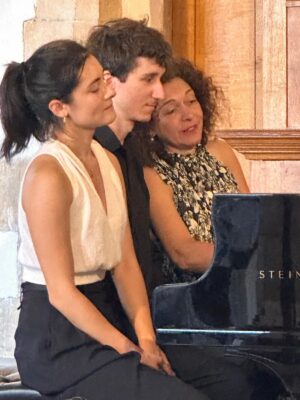 Day Four, Sunday, dawned hot as ever but promising more listening treasure and so it proved. The morning gave us truly delightful Mozart from Marianna Shirinyan with K.330 as the opening of a concert based very cleverly on the number of hands it takes to play a piece. ‘Chapeau!’ to Anthony and Richard for curating the Festival so brilliantly!
After the two-hands Mozart, we had the eight-hands Wagenseil; never heard of him? He was once a very important composer and the suite following K 330 was originally written for three cellos and a double-bass. There was no double bassist around so the pianist of the Astatine Trio ‘dusted off her cello’ (Richard Lester’s expression) and played alongside the other three to excellent effect; eight hands.
Splendid music for four hands was provided by Dvorak and for six by Rachmaninov. Thus: two hands, four hands, six hands and eight hands as advertised.
Sunday afternoon gave us another rarity: Rebecca Clarke’s Morpheus for viola (Edgar Francis) and piano (Berniya Hamie) who made this beautiful work suitably dreamlike. First performed in 1918, under the pseudonym ‘Anthony Trent’ and greeted with enthusiasm, it is only recently that Rebecca Clarke can be acknowledged as its composer and recognized for her talent. Mendelssohn had no need to deny his sex or his magnificent first piano trio which the Astatines did full justice to after the Clarke.
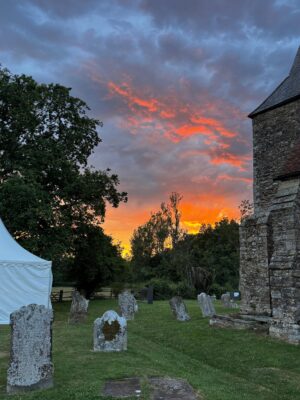
c. Alexander Stiller 2026
And so to the Finale with the Festival that began with a ‘Sunrise’ rapidly approaching its own ‘Sunset’ with a beautiful Bach partita (Marianna Shirinyan:piano) followed by a compelling violin and piano sonata, the only one by Shostakovich (Anthony Marwood: violin and Valentin Magyar: piano) and finally a life-affirming Souvenir de Florence Opus 70 (Marwood/Heath/Lester/Gould/Stumm/Francis) which fulfilled the hopes of the mini-programme and sent us away ‘cheered and rejuvenated’.
Some time ago, the playwright Sir David Hare described the Festival as follows: ‘Peasamarsh, in late June, is a magical Festival’; how right he was and is; the food is good too.